Article Brief:
If your drayage carrier just went out of business or was acquired mid-contract, you likely have shipping containers sitting at a Los Angeles or Long Beach terminal with declining free time. And the thing is, you would not be the only shipper in that spot. FreightWaves counted a dozen small trucking and logistics firms that went bankrupt in the second half of April 2026 alone, citing weak demand, tight margins, and high operating costs.
Many drayage carriers in the LA area seem to have won work over the last two years by bidding right at cost, and a few are out of road. Anyone can move a container. The hard part is getting it to the right dock on time, following through when something breaks, and letting you know before you have to ask. Use that test when vetting the next drayage company you want to work with.
Consider six factors before hiring a new drayage carrier from the many drayage companies in LA: authority and insurance, AB5 compliance, equipment ownership, chassis access, terminal standing, and references. Price still counts, but it just can’t be the only column you sort on.
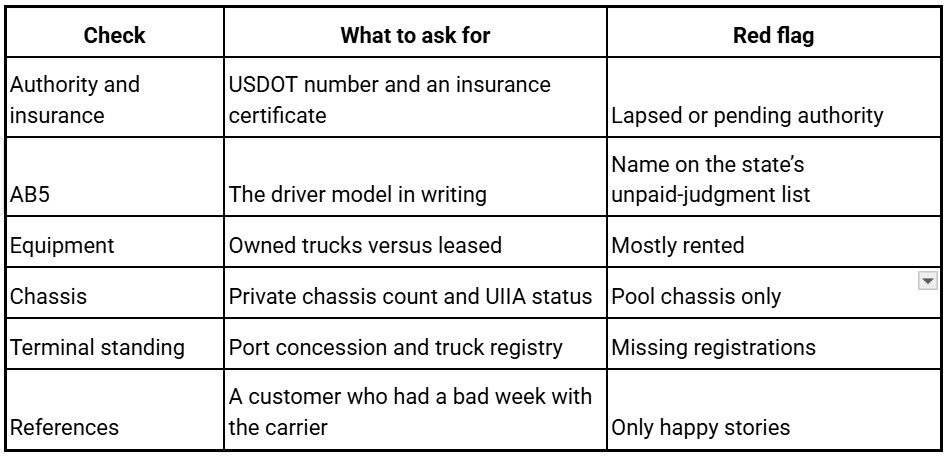
Federal regulations require every interstate drayage carrier to have active FMCSA operating authority and liability coverage of at least $750,000. Search for the carrier by USDOT number on FMCSA’s SAFER site and ask the carrier for a certificate of insurance that lists your business as the certificate holder.
However, working on ports demands more than that. Most drayage carriers sign the UIIA, an agreement that gives them access to equipment requiring $1 million in auto liability coverage and $1 million in general liability coverage. Drivers, meanwhile, require a commercial driver’s license, and the trucks are Class 8 tractors.
AB5 is a California law that classifies drivers. Check the labor commissioner’s list of port trucking companies with unpaid judgments to see if the carrier is on it; if so, you’re liable for what the carrier owes its drivers. After that, ask for the driver model in writing. Fast-responding drayage companies in LA have usually invested time in making sure they are compliant.
A drayage carrier that owns its trucks and chassis has more control over container drayage than one that rents most of its fleet from equipment providers. Determine how many trucks the carrier owns versus leases, how many drivers are employees, and how many chassis are private versus pool units.
A drayage chassis is the wheeled frame that a container rests on. Most chassis in Los Angeles and Long Beach come from shared pools, and when pools are short, container pickup slows for every carrier that relies on them. Carriers with private chassis can keep drayage moving while others sit idle. One note of caution: owned equipment is often financed with debt, so fleet financing is a fair question to ask. While it is tougher to knock down LA drayage companies that own trucks, it doesn’t make them invincible.
The Port of LA’s Clean Truck Program requires every truck that enters the Los Angeles marine terminal to be on the Port Drayage Truck Registry, and every carrier that makes regular calls to have an approved concession agreement. Drivers also need a TWIC card to enter secure port areas unescorted.
Registration gets a truck through the gate. Standing is afterward, and it determines how much time your freight loses between the terminals and warehouses. Ask about the carrier’s process for booking terminal appointments, its procedures for empty container returns, and whether it provides rail drayage to rail ramps and intermodal terminals where intermodal freight is transferred between modes.
The biggest part of the job is reducing delays at those handoffs. Empty container management matters because late returns can cause detention costs to accumulate. Ask about the real-time updates as well. The best LA drayage companies show you their tracking solutions rather than just talk about them.
The real performance measure of a drayage carrier is what happened in your worst week with them, and who called whom. Even the best drayage companies in LA have bad weeks, and a carrier will give you their happiest customers, so ask for one that ships your type of cargo through the same ports to a similar warehouse or distribution center.
Then ask whether the carrier can deliver containers to the final destination on time, how they tracked each shipment to the facility, and how quickly they reported problems before unloading. In our experience, a reference who calmly describes a bad week is a better sign than one who says that nothing ever went wrong.
Reliable drayage services in California include port drayage between ocean ports and local warehouses; rail drayage between rail yards and nearby facilities; and intermodal drayage combining ship, rail, and truck into a single shipment. California drayage companies offer all three, so the differences come down to pricing and communication.
There are three layers of pricing. California drayage companies charge a flat rate per move, add a fuel surcharge, and then add accessorial fees for extras like chassis days, pre-pulls, storage, and waiting time. Because port moves are short distances, time often drives drayage costs more than mileage. Port fees sit on top: the PierPass Traffic Mitigation Fee has been $81.26 for a 40-foot container since August 1, 2026, so ask for the full accessorial schedule in writing.
Real-time updates complete the picture. The best drayage companies in LA will send you status updates at gate-out, delivery, and empty return, so you hear about a problem before your warehouse does.
Golden State Logistics is a drayage company that has been serving the ports of Los Angeles and Long Beach since 1996. Golden State Logistics has 120 company trucks, over 145 drivers, and more than 500 private chassis, so it doesn’t have to rely on pool chassis when pools run short.
Golden State Logistics adopted an AB5-compliant driver model early. Its yards are CTPAT-secured and part of U.S. Customs and Border Protection’s supply chain security program for storage and cross-dock work. Golden State Logistics provides transloading, inland transport, and port drayage. With us, a single team coordinates multiple modes from ship to final delivery for shippers whose transportation needs extend beyond the port. Contact us today to get started.
Q1.What happens to my containers if my drayage carrier shuts down?
When a drayage carrier shuts down, containers still at the terminal keep counting down their free time, and containers already picked up may be sitting in the carrier’s yard or on its chassis. List every container number and location, and note whether each empty container went back. That list is your plan. Move the boxes closest to their last free day first, and give the new provider that list on day one. Most drayage companies in California can start on a short list faster than on a vague one. If the old carrier is in bankruptcy, you may need permission from the trustee or yard owner to access its yard. For fees you think are unfair, the Federal Maritime Commission’s billing rule gives you at least 30 days to dispute a demurrage or detention invoice.
Q2. How are drayage services priced in Los Angeles?
Drayage companies in LA usually charge a flat rate per move plus a fuel surcharge, plus accessorial fees for the shipment’s specific needs, such as chassis days, pre-pulls, storage, and waiting time. That differs from truckload or LTL pricing, which relies on miles. Because port moves cover short distances, time often shapes drayage costs more than mileage, according to RXO. Port fees come on top: the PierPass Traffic Mitigation Fee has been $81.26 for a 40-foot container since August 1, 2026. A low flat rate with heavy accessorials can cost more than a higher all-in quote, so compare total cost per container.
Q3. Why do shippers choose Golden State Logistics for drayage solutions in LA?
Shippers choose Golden State Logistics over other drayage companies in California because the company owns the equipment that keeps containers moving: 120 company trucks and more than 500 private chassis, run by 145 to 150 drivers out of CTPAT-secured yards. Golden State Logistics has served the Los Angeles and Long Beach ports continuously since 1996 and met AB5 requirements early. That ownership gives the Golden State Logistics team direct control over the transportation services and logistics operations a shipper is paying for. A shipper replacing a failed carrier can ask Golden State Logistics for its USDOT number, insurance certificate, driver model, and references before signing, and should.
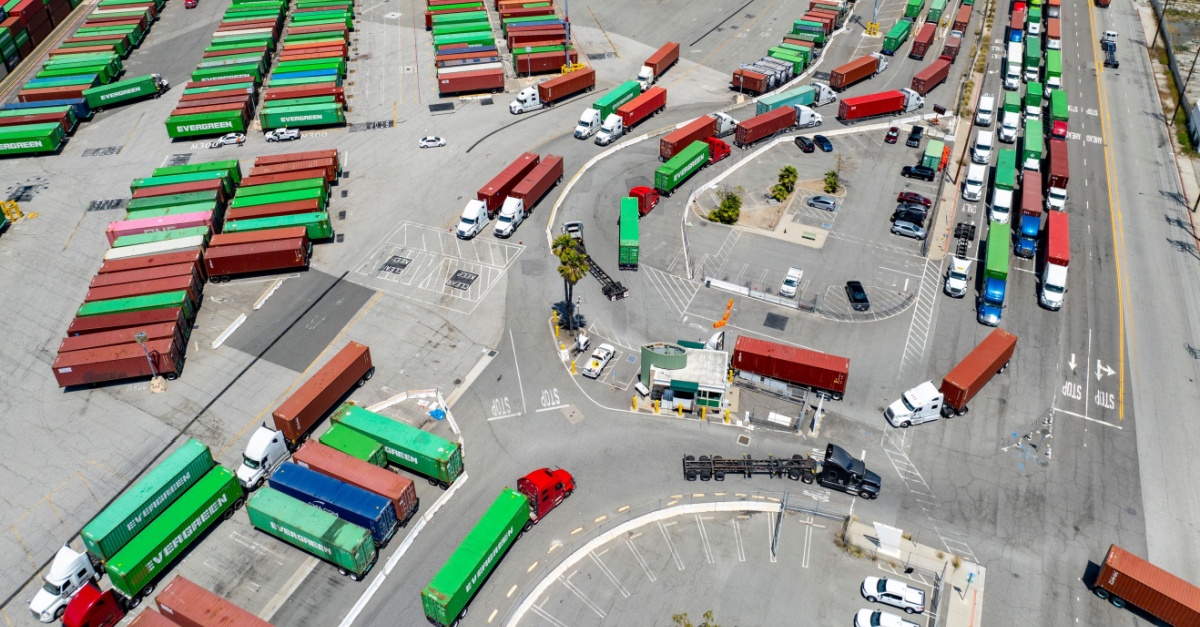
Buying one-off drayage services might sound smart, but it drains time and cash. A solid drayage partnership with a reliable partner expands reach and optimizes the entire freight network for enhanced control and efficiency.
When cargo lands in Los Angeles or Long Beach, every extra mile, every extra hour, and every extra touch becomes a cost and, in many cases, painful delays.
2999 East Pacific Commerce Drive Rancho Dominguez, California 90221
Oakland, CA


